Quick answer: At work, fire prevention starts with identifying what’s in the building. WHMIS labels and Safety Data Sheets tell workers which products can burn, what they react with and how to respond. Workers who can read the flame pictograms and SDS Sections 5, 7, 9 and 10 can spot fire risk before anything ignites.
Key takeaways
- Many of the physical hazard classes in Canada’s Hazardous Products Regulations deal directly with fire.
- Three WHMIS pictograms carry most fire information: the flame, the flame over circle and the exploding bomb.
- Some fire hazards, including combustible dusts, carry no pictogram. Workers have to read the signal word and hazard statement.
- SDS Section 5 covers fire-fighting measures. Sections 7, 9 and 10 cover storage, flammability and reactivity.
- Shipping most lithium batteries requires TDG training and a certificate under Part 6 of the TDG Regulations.
Fire Prevention Week runs October 4 to 10, 2026. This year’s theme from the U.S.-based National Fire Protection Association (NFPA) is “Charge into Fire Safety: Safe Charging Is a Superpower,” and it focuses on lithium-ion batteries and safe charging. It’s an American campaign, but the message applies to Canadian workplaces too. It matters at home. At work, fire prevention starts one step earlier. It starts with knowing what’s in the building.
Every workplace that stores or uses hazardous products already has a fire prevention tool on every container: the Workplace Hazardous Materials Information System, or WHMIS. The supplier label and the Safety Data Sheet (SDS) behind it tell workers what can burn, what it reacts with and what to do when something goes wrong. That information only prevents a fire if the person reading it understands it. That’s what good WHMIS training is for.
Which WHMIS hazard classes are about fire?
WHMIS is Canada’s hazard communication standard, aligned with the Globally Harmonized System of Classification and Labelling of Chemicals (GHS). Health Canada sets supplier requirements under the Hazardous Products Act and the Hazardous Products Regulations (HPR). Federal, provincial and territorial OHS legislation sets what employers must do on site, including worker education.
Many of the HPR’s physical hazard classes deal directly with fire:
- Flammable gases, aerosols, liquids and solids
- Oxidizing gases, liquids and solids, which can cause or intensify a fire
- Pyrophoric liquids and solids, which can ignite on contact with air
- Self-heating substances and mixtures
- Substances and mixtures which, in contact with water, emit flammable gases
- Self-reactive substances and organic peroxides
- Combustible dusts
- Chemicals under pressure, a hazard class added by the HPR amendments that came into force in December 2022
Each class calls for different storage, handling and emergency response. Water on a water-reactive substance makes the situation worse. An oxidizer stored beside a flammable liquid creates a risk neither product carries on its own.
What WHMIS pictograms mean fire risk?
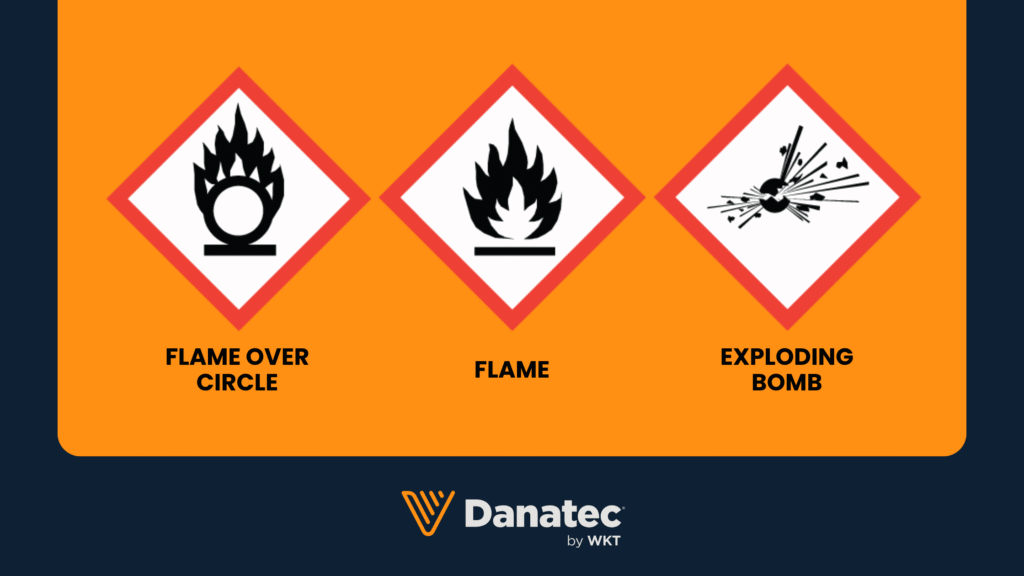
According to the Canadian Centre for Occupational Health and Safety (CCOHS), three WHMIS pictograms carry most of the fire information on a label:
- Flame. Flammable gases, aerosols, liquids and solids, pyrophorics, self-heating and water-reactive substances, most self-reactive substances and organic peroxides, and some chemicals under pressure.
- Flame over circle. Oxidizing gases, liquids and solids.
- Exploding bomb. The most hazardous self-reactive substances and organic peroxides (Types A and B).
Some fire hazards have no pictogram at all. Combustible dusts, combustible liquids (Flammable liquids Category 4) and Flammable gases Category 2 carry a signal word and a hazard statement only. A worker who scans for symbols and skips the text will miss it.
Which SDS sections cover fire?
Schedule 1 of the HPR sets out the 16 sections every SDS must follow. For fire, five of them matter most:
- Section 2, Hazard identification: the classification, signal word and hazard statements.
- Section 5, Fire-fighting measures: suitable and unsuitable extinguishing media, specific hazards arising from the product, and protective equipment and precautions for firefighters.
- Section 7, Handling and storage: safe storage conditions, including incompatibilities.
- Section 9, Physical and chemical properties: flash point, flammability limits and auto-ignition temperature.
- Section 10, Stability and reactivity: conditions to avoid, incompatible materials and hazardous decomposition products.
A worker who checks Section 5 before reaching for an extinguisher, and Section 7 before stacking two products on the same shelf, is doing fire prevention.
Do you need TDG training to ship lithium batteries?
The 2026 Fire Prevention Week theme applies on the job site too. Tools, devices and equipment run on lithium-ion batteries, so charging areas, damaged batteries and storage belong in a site’s fire prevention planning.
Shipping brings a second set of rules. Most lithium battery shipments are regulated dangerous goods under Canada’s Transportation of Dangerous Goods (TDG) Regulations, unless a special provision applies. Transport Canada requires anyone who handles, offers for transport or transports dangerous goods to be trained and to hold a valid training certificate under Part 6. An untrained worker may only do this work under the direct supervision of a certified person who is physically present.
Certificates are valid for 36 months for road, rail and vessel, and 24 months for air. The employer issues the certificate, and both the employer and the employee sign it.
Danatec’s TDG Lithium Batteries Ground Online Training is a one-hour specialty course. It covers lithium battery types and quantities, UN numbers and classification, packaging and storage hazards, and the special provisions that apply. It builds on core TDG, so learners complete TDG Online Training first. It covers ground transport only. Air shipments require separate training.
Why WHMIS training has to build understanding, not just completion
There’s no shortage of WHMIS training on the market, and companies and workers keep coming back to Danatec’s anyway. That’s not because the certificate is easier to get. Training that makes a difference requires learners to understand the real risk in their work, not just complete a module.
Danatec has been training Canadian workers on WHMIS and TDG since 1985. Our WHMIS (GHS) Online Certification Training is updated for the latest HPR amendments, which came into force in December 2022 with a supplier transition that ended December 14, 2025. It goes deep into what happens when hazardous products aren’t handled right. Situations like this occur in real workplaces every year: a flammable liquid stored near an ignition source, an oxidizer shelved beside a fuel, a spill cleaned up with the wrong material.
WHMIS is also an ongoing employer obligation, not a certificate that gets filed and forgotten. Federal, provincial and territorial OHS legislation requires employers to keep worker education current as products, hazards and procedures change.
Round out your fire prevention training
WHMIS tells workers what’s in the building. These short online courses add the skills around it:
- Fire Safety Awareness (30 minutes): ignition sources, the fire triangle and tetrahedron, fire classes, detection and emergency response, and using an extinguisher with the PASS method.
- Hazard Awareness (1 hour): hazard identification, risk assessment, site inspections and Job Safety Analysis.
- PPE Awareness (25 minutes): PPE types, selection, use and care.
Save 15% on WHMIS and fire safety training this October
All October, WHMIS (GHS) Online Certification Training and seven hazard awareness courses are 15% off: Fire Safety Awareness, H2S Awareness, Lockout/Tagout Awareness, Confined Space Pre-Entry, PPE Awareness, Hazard Awareness and TDG Lithium Batteries Ground. Bundles are already discounted and aren’t included.
H2S Awareness and Confined Space Pre-Entry are awareness courses. They don’t replace H2S Alive or confined space entry certification.
Training more than a few people? Set up a corporate account for bulk pricing and completion tracking. Call 1-800-465-3366 or email sales@danatec.com.
Ready to build real fire risk awareness on your team? Get WHMIS training today.
Training a larger crew? Set up a corporate account for your team.
Fire prevention doesn’t start with the extinguisher. It starts with a worker who can read the label, understand the risk and act on it. That’s the kind of education that gets people home to their families safely.
Frequently asked questions
Which section of a Safety Data Sheet covers fire-fighting measures?
Section 5. Under Schedule 1 of the Hazardous Products Regulations, it lists suitable and unsuitable extinguishing media, specific hazards arising from the product, and protective equipment and precautions for firefighters.
Which WHMIS pictograms indicate a fire hazard?
The flame (flammables, pyrophorics, self-heating, water-reactive, and many self-reactive substances and organic peroxides), the flame over circle (oxidizers) and the exploding bomb (Type A and B self-reactive substances and organic peroxides). Some fire hazards, including combustible dusts and combustible liquids, have no pictogram, so workers need to read the signal word and hazard statement.
Do workers need TDG training to ship lithium batteries in Canada?
Yes, in most cases. Most lithium battery shipments are regulated dangerous goods under the TDG Regulations, unless a special provision applies. Anyone who handles, offers for transport or transports them must be trained and hold a certificate under Part 6. It’s valid for 36 months for road, rail and vessel, and 24 months for air.
Is WHMIS training a one-time requirement?
No. WHMIS is an ongoing employer obligation under federal, provincial and territorial OHS legislation. Employers must keep worker education current as products, hazards and procedures change.



Comments are closed.